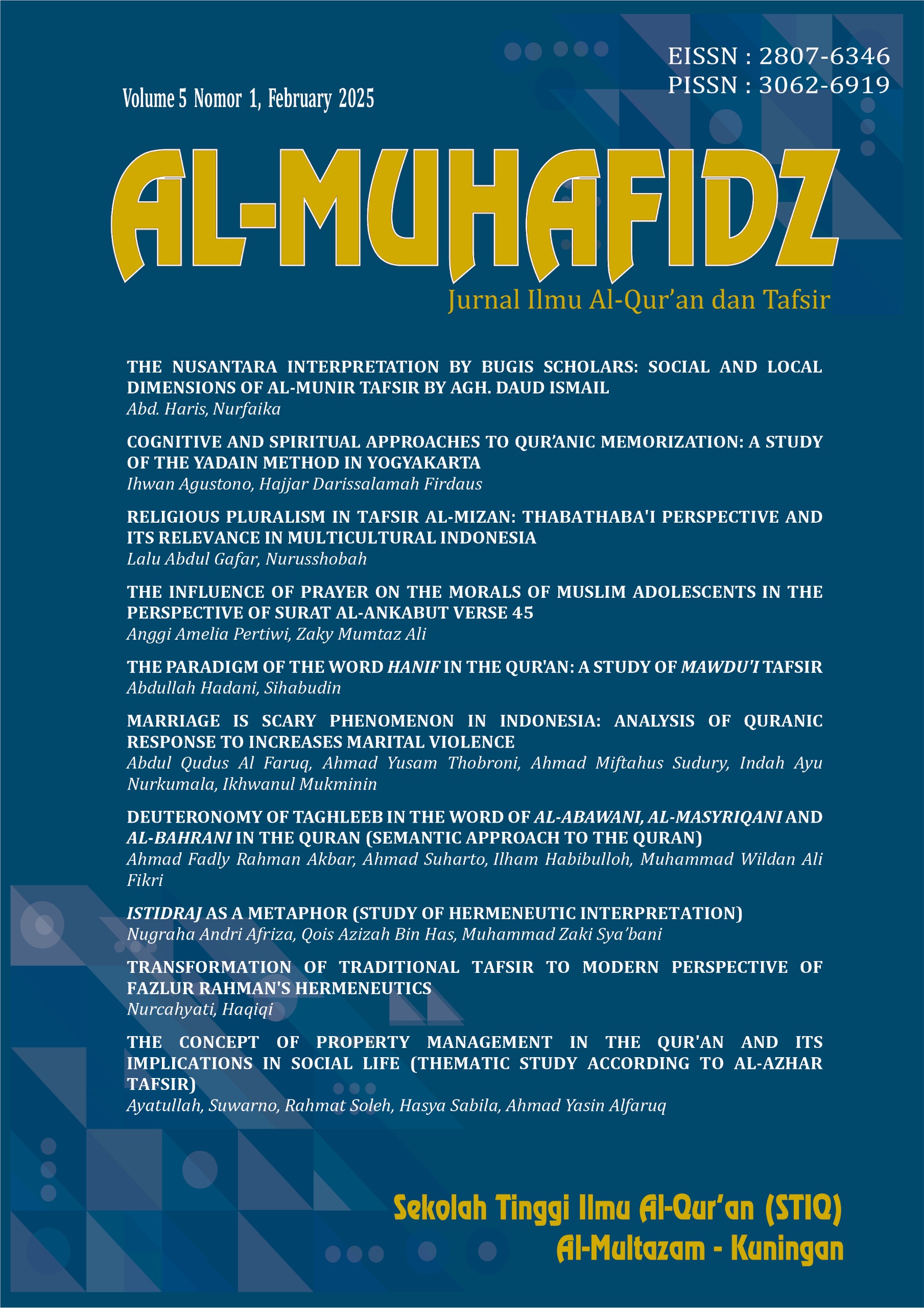
Transformation Of Traditional Tafsir To Modern Perspective Of Fazlur Rahman's Hermeneutics
DOI:
https://doi.org/10.57163/almuhafidz.v5i1.177Keywords:
Hermeneutics, Modern, Tafsir, TraditionalAbstract
This article examines the transformation of tafsir from traditional to modern in the perspective of Fazlur Rahman's hermeneutics. This research was conducted using qualitative methodology with hermeneutic analysis to understand the mufassir's efforts in answering the challenges of the times in a more contextual and relevant way. The traditional textual approach is now replaced by a more unified hermeneutic method, combining social, historical and linguistic analysis. This allows Qur'anic interpretation to deepen meanings that are not only appropriate to the context of the past, but also relevant to modern social, political and cultural realities. The development of globalization and modernity has had a significant impact on the dynamics of tafsir, with modern mufassirs applying adaptive methods to address social issues. However, this transformation faces the challenge of maintaining a balance between innovation and respect for tradition and the authority of the sacred text. The interim conclusion of the study shows that changes in tafsir not only enrich the intellectual horizons of Islam, but also play an important role in developing an understanding and practice of the Qur'an that is more relevant to the context of modern society.
References
Anshori, Muhammad. “Tren-Tren Wacana Studi Al-Qur’an Dalam Pandangan Orientalis Di Barat.” Jurnal Nun 4, no. 1 (2019): 14–41. https://doi.org/https://doi.org/10.32495/nun.v4i1.35.
Arif, Irvandi Mile Muh. “Metodologi Studi Tafsir Al-Qur’an.” Jurnal PEKERTI: Jurnal Pendidikan Islam & Budi Pekerti 4, no. 2 (2022). https://doi.org/10.58194/pekerti.v4i2.3290.
Azra, Azyumardi. Esei-Esei Intelektual Muslim Dan Pendidikan Islam. Jakarta: Logos Wacana Ilmu, 1999.
Dozan, Wely, Farihin, and Lalu Masaji. “Reformasi Tafsir Al-Qur’an Di Era Modern (Telaah Historis Dinamika Dan Transformasi Metodologi ?Interpretasi)?.” Al-Afkar: Journal for Islamic Studies 5, no. 1 (2022): 425–30. https://doi.org/https://doi.org/10.31943/afkarjournal.v5i1.24.
Faqih, Muhammad Wildan. “Sejarah Perkembangan Tafsir.” Journal of Education Research 5, no. 2 (2024). https://doi.org/https://doi.org/10.47467/jdi.v6i1.5835?.
Fathyoni, Rifai Shodiq. “Biografi Fazlur Rahman (1919-1988),” n.d. https://wawasansejarah.com/biografi-fazlur-rahman/.
Haif, Abu, and Rifkatul Mahfudah. “Transformasi Intelektual Dan Kultural: Perkembangan Islam Pasca Serangan Mongol.” Socius: Jurnal Penelitian Ilmu-Ilmu Sosial 1, no. 11 (2024): 436. https://doi.org/https://doi.org/10.5281/zenodo.12607380.
Hamim, Khairul. “Metodologi Tafsir Kontemporer (Kajian Atas Pemikiran Fazlur Rahman).” Jurnal Ilmiah Mandala Education (JIME) 8, no. 3 (2022). https://doi.org/10.36312/jime.v8i3.3780.
Hasanudin, Agus Salim, and Eni Zulaiha. “Hakikat Tafsir Menurut Para Mufassir.” Jurnal Iman Dan Spiritualitas 2, no. 2 (2022). http://dx.doi.org/10.15575/jis.v2i2.18318.
Ibrahim, Musthofa, Nala Hanifatul Magfiroh, and Putri Aulia Nurrizki Fadillah. “Islam Dan Globalisasi.” Jurnal Ilmu Sosial, Manajemen Dan Akuntansi 2, no. 2 (2023). https://melatijournal.com/index.php/jisma/article/view/354.
Jufri, Muhammad Arman Al. “Islam Dan Modernitas: Membaca Pikiran Fazlur Rahman.” UIN Sunan Kalijaga, n.d. https://iatmagister.uin-suka.ac.id/id/kolom/detail/485/blog-post.html.
Kusumawardana, Muhammad Ardi. “Metodologi Kontekstual Dalam Tafsir Ayat Hukum: Studi Literatur Atas Tafsir Klasik Dan Kontemporer,” 3888.
Lewo, Abdullah. “Penafsiran Al-Qur’an Di Era Kontemporer.” Mashadiruna: Jurnal Ilmu Al-Qur’an Dan Tafsir 2, no. 3 (2023). http://dx.doi.org/10.15575/mjiat.v2i3.26108.
Mahmud. Metode Penelitian Pendidikan. Bandung: CV. Pustaka Setia, 2011.
Manaf, Abdul. “Sejarah Perkembangan Tafsir.” Jurnal TAFAKKUR: Jurnal Ilmu Al-Qur’an Dan Tafsir 1, no. 2 (2021). https://doi.org/10.62359/tafakkur.v5i1.
Muhammad, Hadi Mutaman. “Kontribusi Dan Kritik Tafsir Kontemporer.” Jurnal Al-Fikr 17, no. 1 (2013). https://journal.uin-alauddin.ac.id/index.php/alfikr/article/download/2274/2207.
Nata, Abuddin. Pemikiran Pendidikan Islam Dan Barat. Jakarta: Raja Grafindo Persada, 2013.
Nursyifa Naqiya, Hilya Nuri, dkk, Femy Putri. “Criticism of Fazlur Rahman’s Al-Qur’an Hermeneutics.” Jurnal of ‘Ulumul Al-Qur’an and Tafsir Studies 2, no. 1 (2023). https://doi.org/10.54801/juquts.v2i1.170.
Rahayu, Tia, and Alwizar. “Relevansi Sumber Tafsir Al-Qur’an: Perspektif Tafsir Bi al-Matsur, Bi Ar-Ra’yi Dan Bi al-Isyari.” Hamalatul Qur’an: Jurnal Ilmu-Ilmu Al-Qur’an 5, no. 2 (2024): 569–79. https://doi.org/https://doi.org/10.37985/hq.v5i2.337.
Rahman, Fazlur. Islam and Modernity: Transformation of an Intellectual Tradition, n.d.
———. Islamic Methodology in History. Pakistan: Islamic Research Institute’s, 1968. https://ia903207.us.archive.org/2/items/FazlurRahmanIslamandModernity/FazlurRahmanIslamicMethodologyinHistoryIslamic.pdf.
Rizki Ananda, Annisa. “Transformasi Perkembangan Tafsir: Model Tafsir Hadits Modern Fazlur Rahman Sebagai Kritik Terhadap Model Tafsir Sebelumnya.” Al-Dzikra: Jurnal Studi Ilmu Al-Qur’an Dan Hadits 15, no. 2 (2021). http://dx.doi.org/10.24042/al-dzikra.v15i2.5635.
Rozaq, Abd. “Qur’anic Hermeneutics and Its Applications by Fazlur Rahman.” International Journal of Islamicate Social 1, no. 2 (2023): 115. https://doi.org/https://doi.org/10.62039/ijiss.v1i2.27.
Saeed, Abdullah. Interpreting the Qur’an: Towards a Contemporary Approach. New York: Routledge Taylor & Francis Group, 2006. http://islam-and-muslims.com/Abdullah-Saeed-Interpreting-Quran.pdf .
Sakirman. “Konstruk Metodologi Tafsir Modern: Telaah Terhadap Tafsir Al-Manar, Al-Maraghi Dan Al-Misbah.” Hermeneutika: Jurnal Ilmu Al-Qur’an Dan Tafsir 10, no. 2 (2016): 281–92. https://doi.org/http://dx.doi.org/10.21043/hermeneutik.v10i2.3912.
Siwi Fangesty, Maolidya Asri. “Karakteristik Dan Model Tafsir Kontemporer.” Mashadiruna: Jurnal Ilmu Al-Qur’an Dan Tafsir 3, no. 1 (2024). http://dx.doi.org/10.15575/mjiat.v3i1.34048.
Sukandrrumidi. Metodologi Penelitian: Petunjuk Praktis Untuk Peneliti Pemula. Yogyakarta: GADJAH MADA UNIVERSITY PRESS, 2012.
Sulkifli, and Nurul Hikmah Amir. “Kontribusi Metode Double Movement Fazlur Rahman Terhadap Penafsiran Al-Qur’an.” Tafsere 11, no. 1 (2023): 60–74. https://doi.org/https://doi.org/10.24252/jt.v11i1.37050 ?.
Sumantri, Rifki Ahda. “Hermeneutika Al-Qur’an Fazlur Rahman Metode Tafsir Double Movement.” Komunika: Jurnal Dakwah & Komunikas 7, no. 1 (2013): 6. https://ejournal.kopertais4.or.id/susi/index.php/JK/article/download/3314/2335/
Tarigan, Mardinal, M. Indrawan, Nora Khairani, Nur Sakinah, and Windi Harahap. “Peradaban Islam: Masa Kebangkitan Kembali.” Journal on Education 5, no. 4 (2023): 12175–89. https://jonedu.org/index.php/joe/article/view/2178?.
Wardan, Mohamad, Lidya Maharani, Luthfi Khoirunnisa Fadhila, and Asep Abdul Muhyi. “Islam Dan Globalisasi Dalam Kajian Tafsir Al-Qur’an.” Almaheer: Jurnal Pendidikan Islam 2, no. 1 (2024): 48–59. https://doi.org/http://10.63018/jpi.v2i01.30 .
Yudhie, M Haryono. Nalar Al-Qur’an. Jakarta Timur: Nalar, 2002.
Zulaiha, Eni. “Tafsir Kontemporer: Metodologi, Paradigma Dan Standar Validitasnya.” Jurnal Ilmiah Agama Dan Sosial Budaya? 2, no. 1 (2017): 87. https://journal.uinsgd.ac.id/index.php/jw/article/download/780/937?.
Downloads
Published
Issue
Section
License
Copyright (c) 2025 Nurcahyati Nurcahyati, Haqiqi Haqiqi

This work is licensed under a Creative Commons Attribution 4.0 International License.